Tar Heels Fans React to Gritty Showdown Against Michigan State: A Message Surfaces Highlighting Henri Veesaar and Jarin Stevenson’s Efforts, With Another Voice Weighing In on Key Plays That Shaped the Contest; Luka Bogavac and Caleb Wilson Shine Amidst Intense Back-and-Forth Action at Suncoast Credit Union Arena During Fort Myers Tip-Off; While the Score Didn’t Go Their Way, North Carolina’s Resilience, Teamwork, and Moments of Brilliance Spark Conversations and Reactions, Leaving Fans Engaged, Reflective, and Eager to See How the Tar Heels Build on This Memorable Performance in Upcoming Matchups.
The North Carolina Tar Heels faced off against the Michigan State Spartans in an intense matchup during the Fort Myers Tip-Off Beach Division game, held at the Suncoast Credit Union Arena in Fort Myers, Florida, on Thursday, November 27, 2025. The game, marked by fierce competition, showcased the talents and determination of both teams, but ultimately, the Tar Heels suffered a disappointing loss to the Spartans.
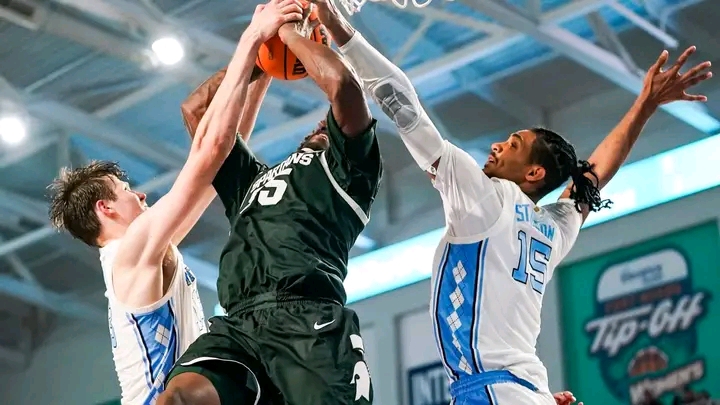
Early in the second half, Michigan State’s forward Coen Carr, wearing jersey number 55, attempted a driving layup toward the basket. However, he was met with formidable resistance from North Carolina’s frontcourt duo. Center Henri Veesaar, sporting the number 13, along with forward Jarin Stevenson, number 15, combined to block Carr’s attempt, highlighting North Carolina’s defensive commitment even as the Spartans pushed aggressively. The play exemplified the high-energy environment of the Fort Myers Tip-Off, where every possession counted and each team fought relentlessly for control.
Another highlight of the game came from Michigan State’s Cameron Ward, forward number 3, who made a concerted effort to penetrate the Tar Heels’ defense. As Ward drove for a layup, he was closely guarded by North Carolina’s Caleb Wilson, forward number 8. Wilson’s defensive stance and timely reaction underscored the Tar Heels’ intent to challenge every Spartan shot and make scoring a tough endeavor. This matchup illustrated the tactical battle on the court, where speed, precision, and positioning played critical roles in determining the outcome of possessions.
Michigan State’s offensive strategy also included sharp perimeter shooting, a key element in modern college basketball. Forward Jaxon Kohler, wearing number 0, took a notable three-point attempt during the second half. The shot reflected the Spartans’ focus on a balanced offensive approach, combining inside drives with outside shooting to stretch the Tar Heels’ defense. Kohler’s ability to find space and execute from distance added a dynamic layer to Michigan State’s attack, keeping North Carolina on high alert throughout the game.
Guard Jeremy Fears Jr., wearing jersey number 1 for Michigan State, showcased his agility and quickness by driving toward the basket in the second half. His movement was closely shadowed by Caleb Wilson, who remained a steadfast defensive presence. The repeated duels between these two players highlighted the intensity of the matchup, where individual skill sets were pitted against strategic defensive schemes. Each drive and contested shot emphasized how critical player matchups were to the flow of the game.
Throughout the contest, both teams demonstrated a high level of teamwork and coordination. The Spartans and Tar Heels repeatedly engaged in fast breaks, pick-and-rolls, and coordinated defensive rotations. The visual energy in the arena was palpable, with fans witnessing a relentless exchange of scoring attempts, defensive stops, and rebounding battles. Each team’s bench offered encouragement, adjustments, and tactical advice, reflecting the coaching strategies implemented to gain an edge in the closely contested matchup.
North Carolina’s Henri Veesaar provided moments of individual brilliance, particularly with his three-point shooting. After successfully converting a long-range basket, Veesaar celebrated with visible enthusiasm, signaling his team’s perseverance even amidst mounting pressure from the Spartans. These key plays demonstrated that while the Tar Heels ultimately fell short, their players remained engaged and capable of impactful contributions on both ends of the court.
The contest also featured multiple instances of strong defensive play by the Tar Heels. Notably, guard Luka Bogavac, wearing number 44, maneuvered skillfully toward the basket during the first half, countered by Michigan State forward Cameron Ward. Such encounters highlighted the athleticism and quick reflexes required in college basketball, as each team strived to limit the other’s scoring opportunities. Defensive intensity, rebounding, and shot contesting remained central themes throughout the game, shaping the narrative of the Spartans’ eventual triumph.
Repeated sequences in the match underscored the back-and-forth nature of the game. The Spartans consistently pressed the Tar Heels, forcing contested shots and capitalizing on turnovers, while North Carolina attempted to establish its rhythm through coordinated passing and inside-outside offensive strategies. These dynamics were particularly evident in the second half, where Michigan State’s offensive execution and timely scoring runs gradually tilted momentum in their favor. Despite North Carolina’s efforts to counteract these runs, the Spartans maintained a level of consistency that ultimately secured their win.
The Fort Myers Tip-Off Beach Division setting provided a unique backdrop for this college basketball clash. Suncoast Credit Union Arena, located in the heart of Fort Myers, offered a vibrant environment with fans from both teams contributing to a lively atmosphere. The venue witnessed a display of athleticism, strategy, and team cohesion, allowing spectators to appreciate the nuances of the game—from defensive rotations to precision shooting and player matchups. Each possession was crucial, and the energy in the arena reflected the significance of the tournament as teams tested their readiness for the broader season.
Throughout the game, Michigan State’s Spartans leveraged both individual talent and collective effort to navigate the challenges posed by the Tar Heels. Their scoring was diversified, featuring drives, mid-range shots, and three-pointers, while their defense effectively limited North Carolina’s inside scoring attempts. For the Tar Heels, moments of brilliance like Veesaar’s three-point shots and Bogavac’s layup drives provided hope and demonstrated their potential, even in a losing effort. The game underscored the competitive nature of college basketball, where skill, strategy, and resilience intersect to determine outcomes.
By the final whistle, the scoreboard reflected Michigan State’s superior execution and ability to capitalize on critical moments, leaving the Tar Heels to regroup and reflect on their performance. Despite the loss, North Carolina exhibited determination, defensive prowess, and flashes of offensive creativity that will likely serve as building blocks for the remainder of the season. For Michigan State, the victory reinforced the effectiveness of their strategies, teamwork, and individual talents, offering momentum and confidence moving forward in the tournament.
In summary, the Fort Myers Tip-Off Beach Division game between Michigan State and North Carolina on November 27, 2025, was a compelling showcase of collegiate basketball at its finest. From the defensive stands by Henri Veesaar and Jarin Stevenson to the offensive drives and shots executed by Coen Carr, Cameron Ward, Jaxon Kohler, and Jeremy Fears Jr., the game highlighted the blend of athletic skill and strategic thinking that defines the sport. North Carolina’s efforts, though ultimately falling short, were marked by moments of individual excellence, particularly in Veesaar’s perimeter shooting and Bogavac’s dynamic playmaking. Michigan State’s disciplined execution and versatile offensive strategies ultimately secured their victory, making this matchup a memorable encounter for fans and players alike. The intensity, energy, and competitive spirit exhibited throughout the contest reflected the enduring excitement and unpredictability of college basketball tournaments, providing a vivid snapshot of both teams’ capabilities and potential as the season progresses.
—
Leave a Reply