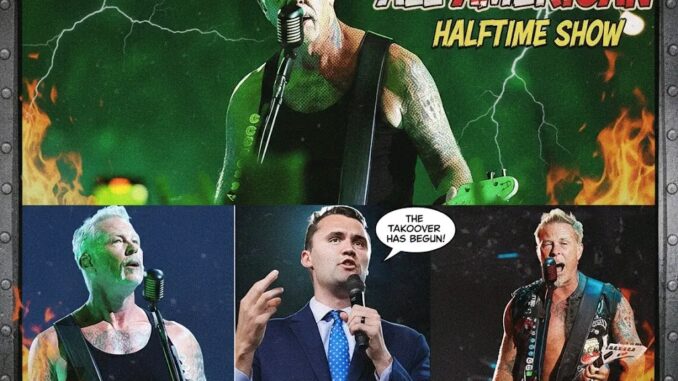
🎸 THE TAKEOVER BEGINS: James Hetfield and the “All American Halftime Show” Rumors Explode Nationwide
By Entertainment & Culture Desk
February 23, 2026
Just weeks after Super Bowl LX dominated headlines, a different kind of halftime debate is setting social media on fire. What began as a conservative counter-programming experiment has rapidly transformed into one of the most talked-about cultural flashpoints of 2026 — and at the center of the storm is one name: James Hetfield.
The frontman of Metallica hasn’t officially signed on to anything. In fact, he hasn’t confirmed involvement at all. Yet hashtags linking his name to the newly launched “All American Halftime Show” are generating millions of impressions daily, fueling speculation that heavy metal’s most enduring icon could become the face of a new entertainment revolution.
A Counter-Movement Is Born
On February 8, 2026, Turning Point USA (TPUSA) officially launched the inaugural “All American Halftime Show” — a self-described patriotic, family-friendly alternative to the NFL’s official broadcast.
Billed as a celebration of “faith, family, and freedom,” the alternative stream aired simultaneously with the NFL’s halftime event, drawing viewers through YouTube and conservative platforms such as Real America’s Voice.
The headliner? Kid Rock, joined by country stars Gabby Barrett and Brantley Gilbert.
While official ratings numbers remain debated, organizers declared the event a “massive success,” claiming millions of concurrent viewers across platforms. Supporters praised the production for offering what they called a “values-driven alternative” to mainstream halftime entertainment.
But almost immediately, another conversation overshadowed the performers who actually took the stage.
The Hetfield Effect
Within minutes of the broadcast announcement earlier this month, hashtags like #AllAmericanHalftime and #HetfieldIgnites began trending worldwide. Fans flooded comment sections with a singular demand: if this is about strength, authenticity, and American grit — then James Hetfield belongs at the front.
The irony is not lost on longtime followers. Hetfield has repeatedly insisted that Metallica is “not a variety show” and has historically avoided overt political alignment. Yet in the hyper-polarized landscape of 2026, symbolism often outweighs statements.
For many in the metal community, Hetfield represents something deeper than ideology: resilience, independence, and raw power. To them, his growling riffs and stadium-filling presence embody the “All-American” ethos far more than choreographed pop spectacles.
“He’s not political — he’s primal,” one viral post read. “If you want fire and freedom, you want Hetfield.”
Redefining Halftime Culture
The “All American Halftime Show” is being framed by supporters as more than just an event — it’s a cultural pivot. Organizers argue that mainstream sports entertainment has drifted too far from traditional values and that millions of Americans feel culturally sidelined.
Critics, however, describe it as a calculated political branding exercise wrapped in concert lighting.
Regardless of perspective, the numbers speak loudly. Clips from the alternative show have amassed tens of millions of views across TikTok, X, and YouTube. Reaction videos alone have turned into mini-industries, with commentators dissecting everything from stage design to audience messaging.
The NFL itself has not formally responded, but insiders note that the league is closely watching the parallel viewership metrics. Whether the alternative format grows into a permanent fixture remains uncertain — yet its immediate impact is undeniable.
The Metal Community Divided
Within heavy metal circles, the conversation is equally intense.
Some fans argue that associating Metallica’s frontman with any overtly political event risks fracturing the band’s famously diverse global fan base. Others counter that rock music has always thrived on rebellion and cultural identity.
Industry analysts point out that Metallica’s brand is uniquely positioned. With decades of cross-generational credibility, stadium-level production experience, and a fiercely loyal fan base known as the “Metal Family,” the band could command a halftime stage — alternative or official — with unparalleled intensity.
Imagining Hetfield roaring through “Enter Sandman” in a pyrotechnic-filled stadium has become a viral daydream. Fans have even mocked up digital posters placing him at center stage in front of red, white, and blue flame graphics.
None of it is confirmed. All of it is trending.
Fire and Freedom as Spectacle
Supporters of the All American Halftime Show describe it as a “statement of pride and unapologetic strength.” Critics describe it as culture war theater.
But perhaps the most fascinating aspect of the unfolding saga is how entertainment itself has become the battleground.
The phrase “Fire and Freedom” — now plastered across countless fan edits — reflects the blending of rock aesthetics with patriotic branding. Whether that formula expands or fizzles will depend largely on who steps forward next.
If TPUSA aims to elevate the spectacle further in 2027, landing a figure of Hetfield’s stature would mark a seismic shift. It would also intensify scrutiny from both supporters and detractors.
Silence from the Source
As of this writing, neither James Hetfield nor Metallica’s management has commented publicly on the rumors.
That silence has only amplified the intrigue.
Entertainment strategists note that even the mere possibility of his involvement generates massive engagement. In an era where digital buzz can eclipse broadcast ratings, trending speculation may be just as valuable as confirmed bookings.
For now, the frontman remains focused on music, with Metallica’s ongoing tour dates selling out arenas worldwide. Whether that trajectory intersects with the All American Halftime Show remains an open question.
A New Entertainment Era?
What is clear is this: halftime entertainment is no longer just about music. It’s about identity, alignment, and audience loyalty.
The success — or controversy — of the All American Halftime Show signals that alternative programming models can gain traction rapidly when amplified by social media ecosystems.
And if James Hetfield ever does take that stage, it won’t simply be a concert.
It will be a cultural moment.
Until then, the riffs are hypothetical, the flames are digital, and the revolution — at least online — is already underway. 🤘🔥
Leave a Reply